Best Shade Structures to Keep Patios Cool Without AC
Best Shade Structures to Keep Patios Cool Without AC
Reading time: 12 minutes
Picture this: It’s a sweltering July afternoon in 2026, temperatures have crept past 97°F, and your once-inviting patio has turned into a solar oven. You’re sweating before you even sit down. Sound familiar? If you’ve been relying on expensive air conditioning to cool your outdoor spaces — or simply suffering through the heat — there’s a smarter, more sustainable path forward.
Outdoor shade structures have evolved dramatically. What used to mean a simple canvas umbrella now encompasses a rich ecosystem of engineered solutions — from motorized louvered roofs to tensioned sail shades and living green canopies. According to a 2025 HomeAdvisor report, homeowners who installed permanent shade structures saw their outdoor space usage increase by an average of 62% during peak summer months, and reported saving up to $40 per month on cooling costs by shifting leisure time outdoors rather than cranking the AC inside.
This guide cuts through the noise. Whether you’re working with a compact urban balcony or a sprawling suburban patio, we’ll walk you through the best shade structures available in 2026, how to choose the right one, and what real-world results look like.
Table of Contents
- Why Shade Matters More Than Ever in 2026
- Top Shade Structures for Patios
- Comparing Your Options: A Side-by-Side Breakdown
- Cooling Effectiveness: The Data Behind the Shade
- Common Challenges and How to Overcome Them
- Real-World Examples That Work
- Frequently Asked Questions
- Your Patio Comfort Roadmap: Next Steps
Why Shade Matters More Than Ever in 2026
We’re living through the hottest decade on record. The National Oceanic and Atmospheric Administration (NOAA) confirmed in early 2026 that the past five consecutive years have ranked among the ten hottest in recorded history. Urban heat islands — the phenomenon where cities absorb and re-emit solar heat — have made outdoor living genuinely uncomfortable in many parts of the United States, Europe, and Australia during summer months.
But here’s the underappreciated truth: shade alone can reduce the perceived temperature of an outdoor space by 10 to 15°F. Researchers at the University of Arizona’s Bioclimatology Lab published findings in late 2025 confirming that strategically placed shade structures can lower surface temperatures on patios by up to 20°F compared to direct sun exposure. That’s a meaningful, quantifiable difference — not just comfort, but genuine heat mitigation.
Beyond comfort, there’s a financial case to be made. The average American household spent $1,580 on cooling costs in 2025, according to the U.S. Energy Information Administration. Shifting outdoor activities to shade-cooled patios — rather than running indoor AC around the clock — directly reduces that number. Think of your shade structure not as a luxury, but as infrastructure with a return on investment.
And the environmental angle? With energy grids under increasing strain during summer peaks, reducing household AC dependency is a genuine contribution. Shade structures produce zero emissions, require minimal ongoing energy, and many options (like living walls or green roofs) actively improve air quality.
Top Shade Structures for Patios
1. Pergolas: The Classic with a Modern Twist
A pergola is perhaps the most versatile and enduring shade structure in the residential landscape. At its core, a pergola is an open-framework overhead structure with rafters, beams, and posts — traditionally made from wood, though aluminum and composite materials have taken significant market share by 2026. What makes pergolas especially compelling today is the integration of modern add-ons: motorized louvered roofs, retractable canopies, built-in LED lighting, and even solar panel integration.
Louvered pergolas — where the roof slats can rotate electronically to control light, airflow, and rain protection — have become the gold standard for upscale patio installations. Brands like Azenco, Brustor, and StruXure offer systems that can be controlled via smartphone app, adjusting the louver angle throughout the day to optimize shade without sacrificing airflow. Prices range from $8,000 to $35,000 installed, depending on size and features.
For budget-conscious homeowners, a traditional wood or aluminum pergola with a shade sail draped over it can achieve excellent cooling performance at a fraction of the cost — typically $2,500 to $7,000 installed.
Best for: Homeowners wanting a permanent, architectural feature that adds property value
Cooling effectiveness: High (especially with louvered or covered variants)
Maintenance level: Low to moderate
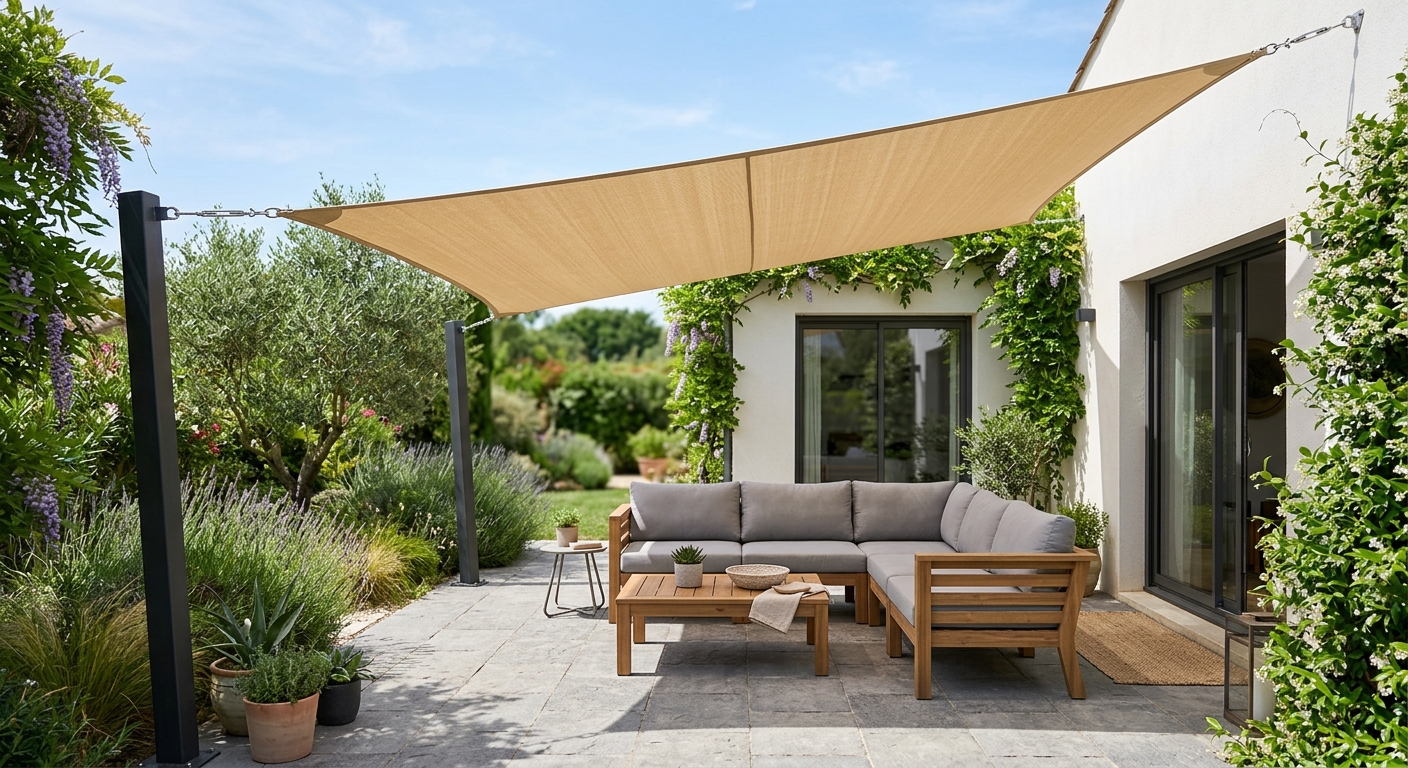
2. Shade Sails: Sculptural and Surprisingly Effective
Shade sails are tensioned fabric panels anchored to posts or existing structures, creating angular, often geometric overhead coverage. They originated in commercial settings — think outdoor dining areas and playgrounds — but have made significant inroads into residential patios over the past decade.
Modern shade sail fabrics, such as high-density polyethylene (HDPE), block 90 to 97% of UV radiation while still allowing airflow, which is crucial for outdoor comfort. Unlike solid roofs, shade sails don’t create stagnant “hot pockets” — the breeze flows through while direct solar radiation is blocked. A 2025 study from the Outdoor Living Industry Association found that shade sails reduced ambient temperature in test patios by an average of 12°F compared to unshaded controls.
Triangular, square, and rectangular configurations can be combined creatively to cover irregular spaces, and they’re available in a wide range of colors — including UV-stabilized whites and neutrals that reflect rather than absorb heat. Costs run from $300 for a DIY kit to $2,000 for professional installation with custom posts.
Best for: Renters, budget-conscious homeowners, irregularly shaped spaces
Cooling effectiveness: Moderate to high
Maintenance level: Low (fabric should be cleaned seasonally)
3. Retractable Awnings: On-Demand Shade
Retractable awnings offer the ultimate in flexibility. Motorized versions, now the dominant format in the 2026 market, can be deployed or retracted in seconds using a remote or smartphone app. Some advanced models integrate weather sensors that automatically retract in high winds and extend when sun intensity crosses a threshold.
Lateral arm awnings — which extend horizontally from a wall mount without support posts — are ideal for patios directly adjacent to the house. They’re available in widths up to 40 feet and projections up to 16 feet, making them suitable for large outdoor entertaining areas. Premium brands like Somfy and Weinor have integrated wind, sun, and rain sensors as standard features on their 2025–2026 product lines.
The trade-off? Retractable awnings require wall mounting (not always possible for all patio configurations) and represent a moderate investment: $1,500 to $6,000 for motorized models installed professionally.
Best for: Patios attached to the house, homeowners wanting flexible coverage
Cooling effectiveness: High when deployed
Maintenance level: Low to moderate
4. Shade Trees and Living Canopies: Nature’s Air Conditioner
Don’t overlook biology as an engineering solution. Mature shade trees — particularly deciduous varieties like red maples, oaks, and zelkovas — provide exceptional cooling through a combination of direct shading and evapotranspiration. A single mature tree can provide the cooling equivalent of five room air conditioners operating for 20 hours a day, according to the U.S. Forest Service.
For homeowners without existing mature trees, fast-growing options like the Empress tree (Paulownia tomentosa) or the tulip poplar can provide meaningful shade within 3 to 5 years. Living walls — vertical structures covered in plants — are also gaining traction in 2026 as both cooling and aesthetic features. They lower surface temperatures through evaporative cooling and provide insulation against radiant heat.
The caveat: trees require years of establishment and can’t be repositioned. Pair them with shorter-term structures for immediate cooling while the green canopy matures.
Best for: Long-term landscape planning, eco-conscious homeowners
Cooling effectiveness: Very high (for mature trees)
Maintenance level: Moderate (seasonal pruning, watering)
5. Gazebos and Pavilions: Full Coverage Solutions
For homeowners who want a fully covered, room-like outdoor experience, gazebos and pavilions represent the premium end of the shade structure spectrum. These are permanent, freestanding structures with a solid or semi-solid roof, four or more posts, and often integrated features like ceiling fans, electrical outlets, and even built-in outdoor kitchens.
A ceiling fan installed within a gazebo can make the space feel 4 to 8°F cooler through wind chill effect — a simple, low-energy enhancement. Polycarbonate roofing panels are popular in 2026 because they allow diffused light while blocking UV and significantly reducing heat gain compared to clear alternatives.
Cost range: $5,000 for a basic prefabricated kit to $50,000+ for a custom architectural pavilion with full amenities.
Best for: Homeowners investing in a permanent outdoor room
Cooling effectiveness: Very high
Maintenance level: Moderate
Comparing Your Options: A Side-by-Side Breakdown
| Shade Structure | Avg. Cost (Installed) | Cooling Power | Permanence | DIY Friendly? |
|---|---|---|---|---|
| Louvered Pergola | $12,000–$35,000 | ⭐⭐⭐⭐⭐ | Permanent | No |
| Shade Sail | $300–$2,000 | ⭐⭐⭐⭐ | Semi-permanent | Yes |
| Retractable Awning | $1,500–$6,000 | ⭐⭐⭐⭐ | Permanent (wall-mounted) | Partial |
| Shade Trees | $200–$1,500 | ⭐⭐⭐⭐⭐ (mature) | Permanent | Yes |
| Gazebo/Pavilion | $5,000–$50,000+ | ⭐⭐⭐⭐⭐ | Permanent | Kit options available |
Cooling Effectiveness: The Data Behind the Shade
Understanding Heat Reduction in Real Numbers
Not all shade is created equal. The cooling effectiveness of any structure depends on several interacting factors: the percentage of direct solar radiation blocked, the material’s reflectivity versus absorptivity, airflow characteristics, and proximity to heat-retaining surfaces like concrete or brick pavers.
Here’s a visual breakdown of average temperature reduction by shade structure type, based on data aggregated from multiple 2025 field studies:
Average Patio Temperature Reduction by Shade Structure (°F vs. Unshaded)
The takeaway? Even the most modest shade sail provides double-digit temperature relief. Pair it with complementary room cooling solutions — like evaporative coolers or misting fans — and you can create a genuinely comfortable outdoor environment even in peak summer conditions.
It’s also worth noting that the surface temperature of patio materials matters enormously. Concrete and dark stone pavers can reach 140°F in direct sun. Shading them reduces surface temps by 40 to 60°F, which eliminates the radiant heat re-emitted upward toward sitting and standing occupants. In other words, shading your floor is almost as important as shading your head.
Common Challenges and How to Overcome Them
Challenge 1: Wind Vulnerability
Shade sails and canopies can become dangerous in high winds if improperly tensioned or anchored. This is one of the most common installation mistakes homeowners make. The solution isn’t to avoid these structures — it’s to size anchor posts correctly (typically 4×4 minimum for residential shade sails, embedded 2 feet in concrete) and use commercial-grade stainless steel hardware rated for the wind loads in your region.
For areas prone to storms, retractable structures with wind sensors are the most practical long-term solution. Set the wind threshold at 23 mph (a common manufacturer recommendation), and your awning will retract automatically before damage can occur.
Challenge 2: Permit and HOA Restrictions
Permanent shade structures — pergolas, gazebos, pavilions — typically require building permits in most U.S. municipalities. Many homeowners associations also regulate the appearance, height, and materials of any structure visible from the street. In 2026, roughly 74 million Americans live in HOA-governed communities, according to the Community Associations Institute.
The practical approach: Check your local municipality’s building department website before purchasing any structure. Many jurisdictions have raised the permit-exempt square footage threshold in recent years (often up to 200 sq ft) to encourage shade installation as a climate adaptation measure. For HOAs, bring your material samples and renderings to a board meeting early in the process — most boards respond better to proactive consultation than to a completed project they didn’t approve.
Challenge 3: Orientation and Sun Angle
The biggest planning mistake homeowners make is installing shade structures without accounting for the sun’s seasonal arc. A structure that provides perfect shade at noon in June might leave your patio fully exposed during the 4 to 6 PM period when you actually use it most. Use a free solar path calculator (many are available as apps in 2026) to model shade coverage throughout the day and across different seasons before committing to a placement or orientation.
As a general rule: Orient your structure to block the western and southwestern sun, which is responsible for the most intense afternoon heat exposure in the Northern Hemisphere.
Real-World Examples That Work
Case Study 1: The Phoenix Small Lot Transformation
Maria and David Chen, a couple in Phoenix, Arizona, had a 300-square-foot concrete patio that was functionally unusable from May through September. In spring 2025, they installed a combination of two overlapping triangular shade sails (one 16-foot and one 12-foot), along with a portable evaporative cooler and a ceiling fan mounted to an existing porch column.
Total investment: $1,850. By mid-summer 2025, they reported using the patio every evening and on weekend mornings — spaces they had previously abandoned entirely. Their indoor AC usage dropped measurably, and they estimated $30 to $45 in monthly savings on their electricity bill. The shade sails were rated for 35 mph winds and required two seasonal tensioning adjustments, each taking about 20 minutes.
Case Study 2: The Pacific Northwest Pergola Project
In Portland, Oregon, landscape architect Tom Reinholt documented a client project in 2025 where a 16×20-foot aluminum louvered pergola was installed over an existing bluestone patio. The clients wanted year-round usability — critical in Portland, where the challenge is often too much sun in summer and too much rain in fall and winter.
The louvered system, which cost $22,000 installed, allowed them to manage both solar gain in summer and rain protection in cooler months. Reinholt noted that the return on investment calculation changed significantly when clients factored in the year-round usability, not just summer cooling. By his estimate, the effective cost per day of use was lower than many budget alternatives that only function seasonally.
Frequently Asked Questions
What is the most cost-effective shade structure for a small patio on a budget?
For budget-conscious homeowners, a HDPE shade sail is the clear winner. A quality 12-foot triangular shade sail with proper anchor posts can be installed for under $500 DIY, provides 90–95% UV blockage, and allows airflow that prevents the stagnant heat that solid structures can trap. Choose a lighter color (white or beige) for maximum reflectivity, and ensure your anchoring hardware is stainless steel to prevent corrosion and maintain tension over time.
Do shade structures require building permits?
It depends on your municipality and structure type. In most U.S. cities, temporary or semi-permanent structures under 200 square feet don’t require a permit, but permanent structures like pergolas, gazebos, and pavilions typically do. Always check with your local building department before beginning installation. Many jurisdictions have streamlined the permit process for residential shade structures in recent years as a response to urban heat island concerns, so the process may be simpler than you expect.
Can I combine multiple shade structures for better cooling?
Absolutely — and this is often the most effective approach. Layering a shade sail with climbing plants (like wisteria or trumpet vine on an adjacent trellis) creates additive cooling through both radiation blocking and evapotranspiration. Similarly, pairing a pergola with a ceiling fan and a portable misting system can push effective temperature reduction into the 20°F+ range, making even extreme heat days manageable. Think of your patio cooling strategy as a system, not a single element.
Your Patio Comfort Roadmap: Next Steps
You now have the framework to make an informed, strategic decision — not just pick a shade structure at random. Let’s crystallize this into action:
- Assess your sun exposure first. Use a solar path app to identify which hours your patio receives the most intense sun. This will directly determine whether you need western coverage, overhead coverage, or both.
- Match your budget to your permanence goals. If you rent or plan to move within five years, shade sails and retractable awnings offer excellent ROI without the permanence of structural installations. If you’re staying put, invest in a louvered pergola or pavilion — the long-term gains justify the upfront cost.
- Layer your cooling strategy. No single shade structure is a complete solution. Combine overhead shading with surface-level interventions (light-colored pavers, outdoor rugs) and airflow enhancers (ceiling fans, strategic misting) for maximum impact.
- Check regulations early. Before you purchase anything, spend 30 minutes researching local permit requirements and HOA rules. This saves significant headaches and potential removal costs.
- Start this season. Even a modest shade sail installed this month means dozens of evenings and weekend afternoons you’ll reclaim from the heat this summer.
As climate patterns continue to push temperatures higher through the late 2020s, the homeowners who invest in outdoor thermal comfort infrastructure now will find themselves significantly ahead — both in quality of life and in property value. Outdoor living spaces are increasingly cited as top-tier home value drivers by real estate analysts in 2026.
Here’s the question worth sitting with: How many summer evenings have you already surrendered to the heat — and how many more are you willing to give up before you act? Your patio is waiting. The shade structures to transform it are available, proven, and more accessible than ever. The only remaining variable is you.
Article reviewed by Linda Phillips, Senior Architectural Consultant & Renovation Project Manager, on June 8, 2026