Strategic Tree Placement Guide for Suburban Illinois Residential Lots
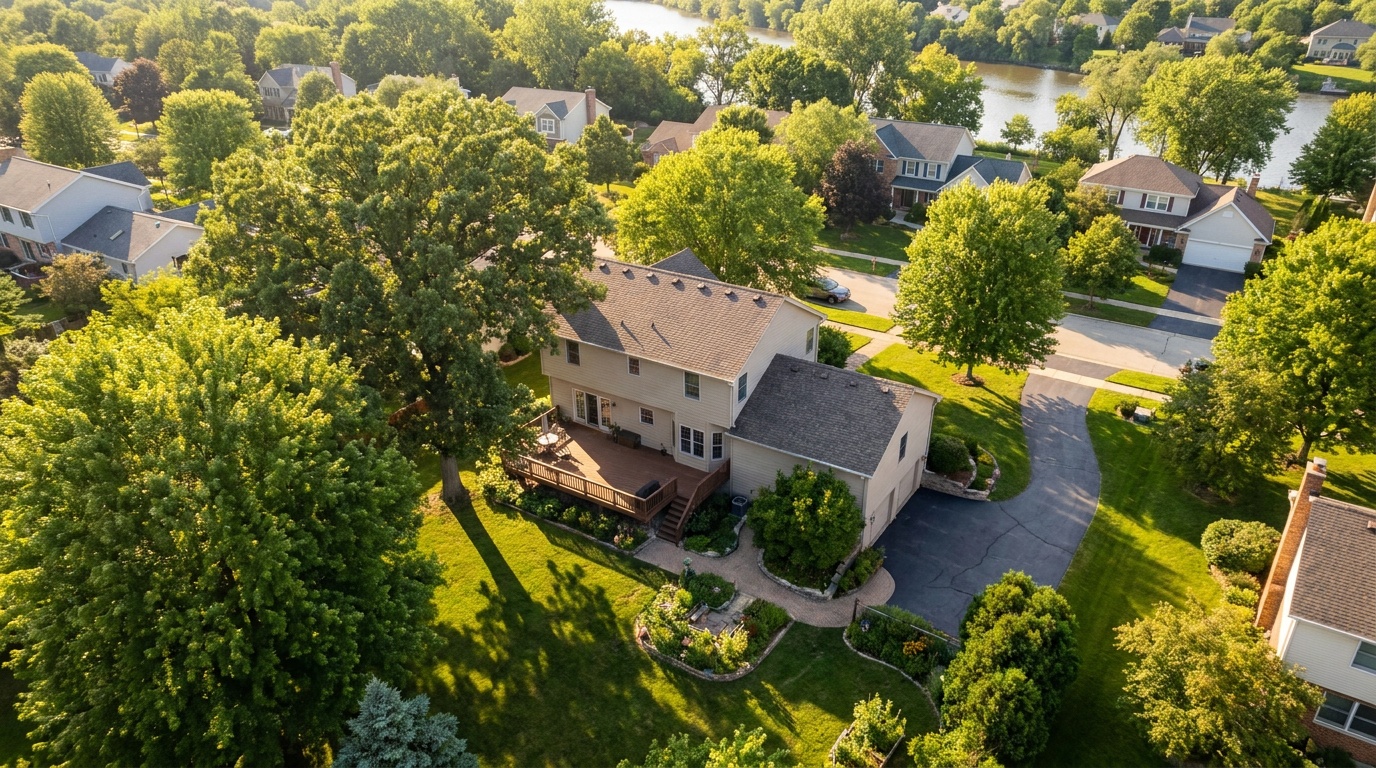
Strategic Tree Placement Guide for Suburban Illinois Residential Lots
Reading time: 14 minutes
Ever stood in your backyard on a sweltering August afternoon in Naperville or Schaumburg, squinting into the sun and thinking, “There has to be a smarter way to design this yard”? You’re not alone. Thousands of Illinois homeowners plant trees without a strategic plan—and they pay for it in cracked foundations, blocked sewer lines, energy bills that spike in January, and eventually, expensive tree removal.
Here’s the straight talk: planting a tree isn’t just a landscaping decision. It’s a 30- to 80-year investment in your property’s comfort, value, and ecological health. Done right, strategic tree placement can reduce your summer cooling costs by up to 35%, increase your property value by 10–15%, and provide essential wildlife habitat in an increasingly urbanized Illinois landscape. Done wrong, it can cost you $15,000 in foundation repairs or a $3,500 emergency removal.
This guide cuts through the confusion and gives you a practical, evidence-based roadmap for placing trees on your suburban Illinois lot with precision and confidence.
Table of Contents
- Why Tree Placement Is More Than Aesthetics
- Understanding Illinois Climate and Soil Conditions
- Setback Rules, Utility Lines, and Local Ordinances
- Strategic Placement Zones: North, South, East, West
- Choosing the Right Species for the Right Spot
- 3 Common Planting Mistakes and How to Avoid Them
- Energy Savings by Tree Placement Strategy
- Tree Comparison Table for Suburban Lots
- Frequently Asked Questions
- Your Suburban Canopy Blueprint: Next Steps
Why Tree Placement Is More Than Aesthetics
Most homeowners think about trees the way they think about furniture—you put them where they look good. But trees are living infrastructure. A mature oak or silver maple isn’t just a pretty backdrop; it’s a functioning system that interacts with your home’s thermal envelope, your underground pipes, your neighbor’s sightlines, and your municipality’s utility corridors.
According to the U.S. Forest Service’s i-Tree program, a single strategically placed shade tree on the west or southwest side of a home can save between $100 and $250 annually in cooling costs over its lifetime. Multiply that across a 60-year lifespan, and you’re looking at a real financial return that dwarfs what you’d spend on the tree itself.
But placement errors are devastatingly common. The Illinois Extension Service reported in 2025 that approximately 42% of residential tree removals in the Chicago metropolitan area were directly attributable to poor initial placement—trees planted too close to structures, utility easements, or septic systems. That’s not just money lost; it’s decades of ecological contribution wiped out because someone didn’t measure twice before digging.
“The best time to think about where a tree will be in 40 years is before you plant it. Most homeowners only think about where it is today.”
— Dr. Linda Haugen, Plant Pathologist, USDA Forest Service Northern Research Station
The good news? With some upfront planning, you can avoid every major pitfall. Let’s build that plan together.
Understanding Illinois Climate and Soil Conditions
The Illinois Hardiness Zone Reality in 2026
Suburban Illinois sits primarily within USDA Plant Hardiness Zones 5b and 6a, though the ongoing northward creep of warmer zones means that areas like the southern Chicago suburbs—Joliet, Bolingbrook, Mokena—are increasingly flirting with Zone 6b conditions. In practical terms, this matters enormously for tree selection. Species that were borderline 20 years ago, like Bald Cypress (Taxodium distichum) and Sweetbay Magnolia, are now viable performers in many suburban Illinois yards.
Illinois summers are hot and humid, with July averages around 85°F in the greater Chicago metro. Winters can be brutally cold, with January lows frequently dipping below 0°F in northern suburbs like Lake Forest, Arlington Heights, and Wheaton. Any tree you plant must be able to handle both extremes—a reality that eliminates many species otherwise popular in warmer states.
Soil Conditions: What’s Really Under Your Lawn
Here’s what most homeowners don’t know: suburban Illinois soils are often dramatically different from native Illinois soils. Decades of construction, grading, and topsoil removal have left many suburban lots with compacted clay subsoil sitting just 4–8 inches below a thin veneer of imported topsoil or sod. This matters because:
- Heavy clay soils drain poorly, creating root rot risks for species that need good drainage
- Compacted soils restrict root spread, leading to structurally unstable trees prone to wind throw
- Alkaline pH (common in Illinois at 7.0–8.0) can cause iron chlorosis in species like pin oak (Quercus palustris), leading to yellowing leaves and poor health
Before you plant anything, invest $25–$40 in a University of Illinois Extension soil test. It will tell you pH, organic matter content, and drainage characteristics—information that directly determines which species will thrive and which will struggle for 20 years before dying prematurely.
Pro Tip: The U of I Extension Soil Testing Lab in Urbana-Champaign processes results within 2 weeks and provides specific amendment recommendations. In 2026, they also offer digital results delivery with GIS-linked recommendations for your specific county.
Setback Rules, Utility Lines, and Local Ordinances
This is the section most homeowners skip—and it’s the one that causes the most expensive problems. Before you plant a single tree, you need to answer three critical questions:
- Where are your underground utilities?
- What are your municipality’s setback requirements?
- Are there HOA-specific tree regulations on your property?
In Illinois, you are legally required to call JULIE (Joint Utility Locating Information for Excavators) at 811 at least 48 hours before any digging. This is not optional—it’s Illinois state law under the Illinois Underground Utility Facilities Damage Prevention Act. JULIE will mark gas, electric, telecom, and water lines on your property at no charge. Tree roots from large-caliper species like silver maple or Norway maple can infiltrate clay sewer tiles within 5–10 years, creating blockages that cost $2,000–$8,000 to remediate.
General Setback Guidelines for Suburban Illinois
While every municipality has its own specific code, the following general guidelines represent best practices widely adopted across DuPage, Cook, Will, Kane, and Lake counties:
- Large trees (mature height over 50 ft): Minimum 20 feet from the home foundation; 15 feet from underground utilities; 10 feet from property lines
- Medium trees (mature height 25–50 ft): Minimum 15 feet from foundation; 10 feet from utilities; 8 feet from property lines
- Small trees (mature height under 25 ft): Minimum 8 feet from foundation; 5 feet from utilities; 5 feet from property lines
- Overhead power lines: Only species maturing under 25 feet should be planted within 25 feet of power lines
Several municipalities, including Naperville, Downers Grove, and Evanston, have tree preservation ordinances that require permits for removing existing trees above a certain caliper diameter (typically 10–12 inches DBH). If you’re removing existing trees to re-landscape, check with your village hall first. Fines for unpermitted removal can reach $500–$2,000 per tree in 2026.
Strategic Placement Zones: North, South, East, West
Think of your lot as a compass. Each cardinal direction offers different solar exposure, wind patterns, and therefore different strategic opportunities for tree placement. This is where you can turn your yard into a genuine energy-efficiency and comfort system.
The South and West Sides: Your Cooling Powerhouses
In Illinois, the most intense summer sun hits from the south and west. Planting deciduous shade trees on these sides delivers a double benefit that no other landscaping element can match: summer shade that blocks 60–90% of solar radiation, and winter transparency (once leaves drop) that allows passive solar heating when you need it most.
Case Study — The Kowalski Family, Lisle, Illinois (2024): After planting two large-caliper Red Maples (Acer rubrum ‘October Glory’) on the southwest corner of their 1970s ranch home in 2019, the Kowalski family documented a consistent 28% reduction in summer cooling costs over five years. Their ComEd bills for June through September averaged $340 before planting and $245 after. Total tree investment: $1,800. Total five-year savings: approximately $475. By 2026, the trees are approaching 25 feet in height and the energy benefits continue to compound.
Ideal species for south and west placement on suburban Illinois lots:
- Quercus rubra (Northern Red Oak) — Fast-growing, tolerates clay, 50–75 ft mature height
- Acer rubrum (Red Maple) — Adaptable, beautiful fall color, 40–60 ft
- Gymnocladus dioicus (Kentucky Coffeetree) — Drought-tolerant, low-maintenance, 60–75 ft
The North Side: Windbreak Territory
Illinois winters arrive with prevailing winds from the northwest. Evergreen windbreaks on the north and northwest sides of your property can reduce heating costs by 10–25% by blocking cold air infiltration around your home’s foundation and walls. The key is using evergreen species that provide year-round wind protection.
Recommended evergreens for northern Illinois windbreaks:
- Picea glauca (White Spruce) — Superior cold hardiness, dense branching to ground level
- Thuja occidentalis (Arborvitae) — Columnar forms excellent for smaller lots with space constraints
- Pinus strobus (Eastern White Pine) — Fast-growing, graceful appearance, tolerates a range of soils
Pro Tip: For maximum windbreak efficiency, plant evergreens in a staggered double row 10–15 feet apart, positioned 50–100 feet from the home on the north and northwest sides. This creates a “turbulence buffer zone” that deflects wind up and over the structure.
The East Side: Morning Sun and Gentle Shade
East-facing trees receive morning sun and afternoon shade—a benign exposure that offers flexibility in species selection. This is an ideal location for smaller ornamental or fruit trees that can’t handle intense afternoon heat. Consider Amelanchier (Serviceberry), Prunus varieties (ornamental cherries), or even Malus cultivars (crabapples) designed for Illinois disease resistance.
Choosing the Right Species for the Right Spot
Illinois’s tree scene has evolved significantly by 2026. The Emerald Ash Borer (Agrilus planipennis) has now decimated over 95% of Illinois’s native ash tree population, leaving massive canopy gaps in suburban neighborhoods across the state. Meanwhile, the Asian Longhorned Beetle remains a monitored threat in certain Cook County areas. This pest-pressure reality means species diversity is no longer optional—it’s essential resilience strategy.
The guiding principle used by urban foresters today is the 10-20-30 Rule: no more than 10% of the urban forest should consist of any single species, no more than 20% from any single genus, and no more than 30% from any single plant family. Apply this thinking even at the individual lot level by diversifying your tree selections across species.
Case Study — Village of Wheaton Urban Forestry Program, 2025: After losing an estimated 4,200 ash trees between 2015 and 2024, Wheaton’s public works department launched a replacement initiative prioritizing species diversity. Their 2025 planting list included 22 different species, with particular emphasis on Swamp White Oak (Quercus bicolor), American Linden (Tilia americana), and Chinkapin Oak (Quercus muehlenbergii). Homeowners were offered subsidized trees at $15–$45 each through a cost-share program. In 2026, the program continues and is worth checking for your municipality.
Species to avoid on suburban Illinois lots despite their historical popularity:
- Silver Maple (Acer saccharinum): Aggressive surface roots, weak wood prone to storm damage
- Siberian Elm (Ulmus pumila): Invasive tendencies, brittle branches, poor form
- Bradford Pear (Pyrus calleryana ‘Bradford’): Structurally weak, invasive in Illinois, now banned for sale in the state as of 2024
- Norway Maple (Acer platanoides): Invasive, out-competes native understory plants
3 Common Planting Mistakes and How to Avoid Them
Mistake #1: Planting Too Deep
The single most common tree planting error is burying the root flare—that visible widening at the base of the trunk where roots begin to spread outward. When planted too deep, trees develop a condition called “trunk girdling,” where roots grow in circles around the buried trunk and eventually strangle the tree. This can take 10–20 years to manifest, making it a silent killer. Solution: Plant so the root flare is at or slightly above grade level. When in doubt, plant higher rather than lower. Remove any excess soil from the nursery container that may be covering the flare before planting.
Mistake #2: Wrong Tree, Wrong Size Lot
Homeowners consistently underestimate mature tree size. A Kentucky Coffeetree purchased as a 6-foot sapling will reach 60–75 feet at maturity with a canopy spread of 40–50 feet. On a standard 75 x 125-foot suburban lot, this is a significant commitment. Solution: Always research the mature dimensions of any tree before purchasing. Check the Arbor Day Foundation’s tree database or the Morton Arboretum’s plant selector tool, which was updated in 2025 with Illinois-specific climate-adjusted recommendations.
Mistake #3: Neglecting Post-Planting Care in the Critical First 3 Years
Trees are most vulnerable during establishment—the first 3 years after planting. During this period, they need consistent supplemental watering (1 inch per week when rainfall is insufficient), proper mulching (3–4 inch depth in a donut shape keeping mulch away from the trunk), and protection from lawnmower and string trimmer damage. Mechanical damage from mowers is the leading cause of young tree death in suburban settings. Solution: Install a 4-foot diameter mulch ring around every newly planted tree and stake a reminder in your calendar to water weekly during dry spells from May through September for the first three years.
Energy Savings by Tree Placement Strategy
The data below represents average annual energy savings for a 2,000 sq ft suburban Illinois home based on strategic tree placement, compiled from University of Illinois Extension research and the U.S. Forest Service i-Tree model outputs updated in 2025.
Annual Energy Savings by Placement Strategy
Source: U.S. Forest Service i-Tree Model / University of Illinois Extension, 2025 data. Values represent averages for 2,000 sq ft homes in USDA Zones 5b–6a.
Tree Comparison Table for Suburban Illinois Lots
| Species | Mature Height | Best Placement | Soil Tolerance | Pest/Disease Risk |
|---|---|---|---|---|
| Swamp White Oak (Quercus bicolor) | 50–60 ft | SW, S shade | Wet/clay tolerant | Low |
| Red Maple (Acer rubrum) | 40–60 ft | SW, W cooling | Adaptable, prefers acidic | Low–Moderate |
| White Spruce (Picea glauca) | 40–60 ft | N, NW windbreak | Adaptable, moist preferred | Low |
| Serviceberry (Amelanchier canadensis) | 15–25 ft | E, near structures | Moist, well-drained | Low |
| Kentucky Coffeetree (Gymnocladus dioicus) | 60–75 ft | SW, large lots only | Drought-tolerant, clay OK | Very Low |
Frequently Asked Questions
How far should I plant a tree from my home’s foundation in suburban Illinois?
The distance depends on the tree’s mature size. For large-canopy trees reaching 50 feet or more (like oaks or maples), maintain a minimum of 20 feet from the foundation. Medium trees (25–50 ft) should be planted at least 15 feet away, while small ornamental trees (under 25 ft) can be placed as close as 8 feet. However, always factor in the lateral root spread, which typically extends 1.5 to 2 times the tree’s mature height. Clay soils common in Illinois can cause roots to travel horizontally in search of oxygen, making generous setbacks especially important. When in doubt, consult a certified arborist (ISA-certified) for a site-specific assessment before planting.
Which trees are best for fast privacy screening in Illinois suburbs without causing long-term problems?
Homeowners often reach for fast-growing species like Leyland Cypress or Green Giant Arborvitae for quick privacy, but results vary significantly in Illinois’s climate. The best performers for suburban Illinois privacy screens in 2026 are Thuja occidentalis ‘Emerald’ (Emerald Arborvitae) for tighter spaces—growing 12–15 feet tall with a narrow 3–4-foot spread—and Picea glauca (White Spruce) for larger-scale screening. For a mixed naturalistic screen that also supports pollinators and birds, consider alternating native shrubs like Ilex verticillata (Winterberry) and Viburnum lentago (Nannyberry) with small trees like Serviceberry. Avoid Leyland Cypress in Zone 5b areas as it frequently suffers winter dieback in harsh Illinois winters.
Do I need a permit to plant a new tree in my suburban Illinois yard?
In most suburban Illinois municipalities, you do not need a permit to plant a new tree on your private residential property. However, there are important exceptions. If your lot is within a designated floodplain, has deed restrictions, or falls under a homeowners association with landscape covenants, additional approvals may be required. Planting within public right-of-way strips (the grass area between your sidewalk and the street curb) typically requires a village permit and often mandates species approval, as that strip is technically municipal property. Additionally, if you are removing existing protected trees (generally 10–12 inches diameter at breast height or larger) as part of a replanting project, a removal permit is commonly required. Always contact your village hall’s community development or public works department before major tree work to confirm local requirements for 2026.
Your Suburban Canopy Blueprint: Next Steps
You now have everything you need to approach your suburban Illinois lot with the confidence of a certified arborist and the practicality of a seasoned homeowner. Trees are not impulse purchases or afterthoughts—they are 30- to 80-year infrastructure decisions that will outlive your mortgage, potentially your tenure in the home, and certainly your lawnmower. Getting the placement right from the start is the single highest-leverage action you can take.
Here’s your actionable roadmap for 2026:
- Order your soil test this week. Contact the University of Illinois Extension at extension.illinois.edu and request a standard home lawn and garden soil test. Results in hand, you’ll make far smarter species choices.
- Call JULIE (811) before any digging. Map your underground utilities and overlay them with your lot dimensions. This becomes your planting constraint map.
- Sketch your placement zones. Using your lot survey or a simple Google Maps satellite view, identify your SW, NW, and E zones. Mark where large, medium, and small trees can realistically go given setback requirements.
- Select 2–3 species from this guide’s recommended list that match your soil conditions, lot size, and energy goals. Prioritize native or regionally adapted species for long-term resilience.
- Check your municipality’s subsidy programs. In 2026, dozens of Illinois communities from Aurora to Wilmette offer cost-share tree programs, free trees, or planting assistance. A single phone call to your village forestry department could save you $50–$200 per tree.
As Illinois’s urban heat island effect intensifies and communities grapple with post-EAB canopy recovery, the suburban homeowner who plants strategically today becomes part of the larger regional solution tomorrow. Your yard is not an island—it’s a node in a 6-million-acre urban forest ecosystem that stretches across Chicagoland and beyond.
Here’s the question worth sitting with: Forty years from now, what do you want the shade on your property to say about the decisions you made today? Plant the right tree, in the right place, for the right reasons—and let it speak for generations.
Article reviewed by Linda Phillips, Senior Architectural Consultant & Renovation Project Manager, on May 4, 2026